

TREATMENT AND PREVENTION OF OSMOSIS IN BOATS
Osmosis is a process that affects fiberglass laminates and gelcoats on boats. It occurs when water penetrates the protective gelcoat layer and reacts with uncured contaminants within the laminate, generating acidic compounds. This increases internal pressure, causing blistering, cracking, and even a loss of the hull's structural integrity if left unaddressed.
Although it usually manifests after years of use, the appearance of osmosis depends on construction quality, temperature, and water type. Factory defects in resin curing or a lack of sealing in the bilges—where corrosive liquids and water accumulate—accelerate this process.
WARNING SIGNS ON THE HULL
- Liquid blisters: These range in size from a pinhead to the palm of a hand. If the liquid inside emits a sour smell or taste, or is sticky/greasy, the probability of osmosis is very high. (Note: Dry, odorless blisters are usually air pockets and do not represent osmosis).
- Star cracks: Caused by flexing or impacts on brittle gelcoats, allowing water filtration.
- Pinholes: Porosity caused by tiny bubbles that reduce the gelcoat's impermeability.
- Prominent fibers: Act as wicks that absorb water by capillary action into the interior of the laminate.
- Poor polymerization: Areas where resin was mixed or applied under improper conditions.
PREVENTION STRATEGY
For new boats or healthy hulls, a protective barrier coat of epoxy resin is applied.
- Recommended thickness: A total coat of 900 microns (approximately 5 coats of 150 microns applied with a roller).
- Preparation: Degrease with a specific wax-removing solvent, sand the surface, and ensure the complete removal of dust or contaminants.
- Application: Alternate contrasting colors for each coat to guarantee uniform coverage without leaving blind spots.
STEP-BY-STEP REPAIR PROCESS
When damage is widespread, a structured remediation process must be executed:
- Gelcoat removal: By electric peeling, sandblasting, or hydro-blasting, removing all damaged material without affecting the sound laminate. Isolate the work area with plastic tenting.
- Washing and neutralization: Rinse the exposed fiber with pressurized water at least twice a week to remove acidic substances exuded by the hull.
- Deep drying: Allow the hull to dry naturally (which can take several weeks) in an area exposed to the sun.
- Moisture measurement: Use a contact moisture meter until readings of 14% or lower are obtained. (Avoid false readings by isolating areas with tanks or metal components behind the hull).
- Priming and sealing: Apply the first coat of solvent-free epoxy resin. Fill imperfections with epoxy fairing compound to restore the hull's profile.
- Final coats: Apply three coats of high-build epoxy resin and two coats of epoxy primer (ideally "wet-on-tack" or by sanding the gloss between coats) before applying the final antifouling paint.
PARTIAL REPAIR FOR LOCALIZED BLISTERS
If the problem only affects specific areas or the rudder, full repair can be postponed through localized treatment:
- Mark and identify blisters before they drain their liquid.
- Open and scrape the affected area until healthy laminate is reached.
- Wash with fresh water and allow to dry for weeks to months until it stops exuding acids.
- Seal the cavity with low-density epoxy resin, fill with epoxy fairing compound, sand, and reapply antifouling.
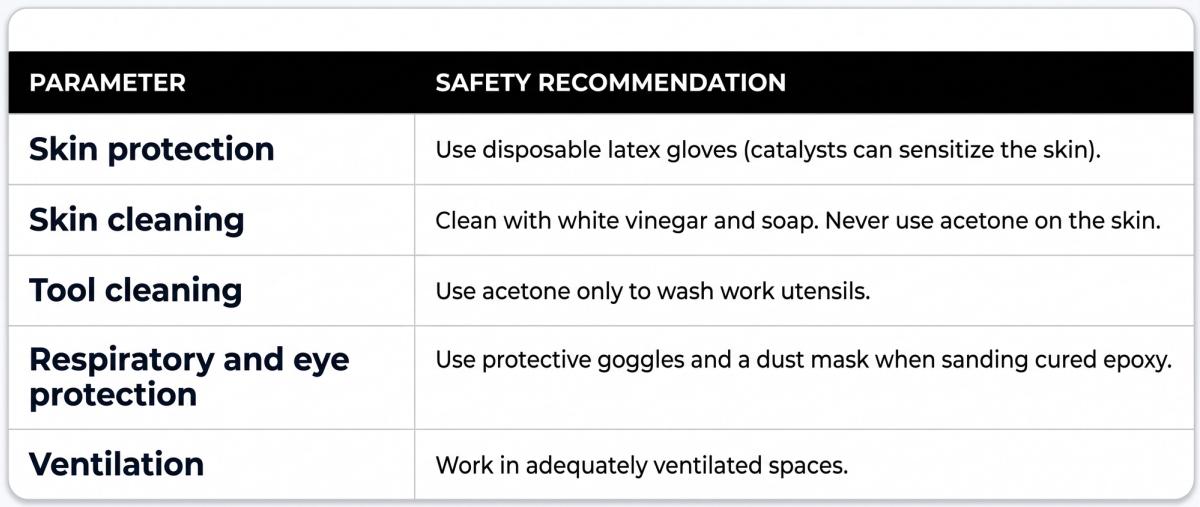
PROPERTIES OF EPOXY RESIN AND SAFETY MEASURES
Unlike polyester resins, epoxy resin is a two-component thermosetting polymer that offers superior adhesion, excellent chemical and mechanical resistance, high hardness, and zero shrinkage upon curing.
MYTHS AND FREQUENTLY ASKED QUESTIONS ABOUT BOAT OSMOSIS Osmosis in boats is surrounded by several myths and misconceptions that cause confusion among boat owners. Below are the most common myths, the truth behind them, and answers to the most frequently asked questions.
COMMON MYTHS ABOUT OSMOSIS
- It only happens to old boats: Although older boats are more likely to show blisters, osmosis can also appear on newer vessels. This mainly occurs if the laminate or barrier coat quality is poor, or if moisture enters the hull due to contamination during construction.
- Every blister is a disaster: Small, isolated blisters are often purely cosmetic, especially if they do not penetrate deep into the laminate. Severe osmosis involves structural issues, such as when water degrades the resin through hydrolysis. Many boats sail for years with a few small blisters without serious consequences.
- It is caused by poor maintenance: Maintenance can influence how it develops, but the main cause lies in chemical and manufacturing factors, not in how often you wash or wax the boat.
- Drying the hull in the sun will fix the problem: Drying a blistered hull in the sun does not eliminate osmosis. While it will evaporate surface moisture, the underlying chemical reaction will continue unless the laminate is cleaned, remediated, and resealed with proper epoxy barrier coats.
- Blisters occur because of water leaks: Osmosis does not happen because water leaks through cracks or holes. It is a diffusion process in which water molecules pass through the gelcoat (which acts as a semi-permeable membrane) due to concentration differences.
- Epoxy coatings prevent it 100%: Epoxy barrier coats greatly reduce water permeability, but they do not make the hull completely waterproof. Over time, small imperfections or minor damage can still allow slow water ingress.
- A boat with osmosis is worthless: Many vessels with professional osmosis treatments function just as well and sell for near the value of unaffected boats, especially if the repair is documented. However, if a boat is sold with active, unrepaired blisters, its market value will decrease.
- Osmosis spreads rapidly: It is usually a very slow process, and blisters can take years to develop. It is rarely necessary to panic or organize costly repairs immediately, unless a technical survey reveals deep structural failures.
FREQUENTLY ASKED QUESTIONS
Can osmosis sink a boat? Osmosis does not make the hull porous enough to let in large amounts of water all at once. However, it can delaminate fiberglass layers or weaken the hull's structural strength over time. This creates weak spots that could crack under extreme pressure (such as grounding or a collision). In short: osmosis will not directly sink a boat, but a severe, untreated case can weaken it to the point where another failure might.
Can osmosis be prevented? Risk can be significantly reduced by conducting periodic inspections below the waterline, applying marine-grade barrier coatings to block water penetration, and keeping the boat out of the water (dry-stored) when not in use.
Should I buy a boat with osmosis? Many blisters are purely cosmetic, but they can indicate laminate damage if water has penetrated deeply. If the blisters are small and the boat is in excellent overall condition at a good price, it can be a viable purchase. However, widespread or large blisters require expensive repairs. If in doubt, hire a marine surveyor to evaluate whether the damage is cosmetic or structural; this will also serve as leverage to negotiate a lower price.
#FiberglassDamage #BoatMaintenance