

THE FAST WHITE MARLIN

Found exclusively in the Atlantic Ocean and the Caribbean Sea, the white marlin is one of the three species that make up the coveted "Grand Slam" of sport fishing on the Venezuelan coast, alongside the blue marlin and the sailfish.
The white marlin (Kajikia albida) belongs to the Istiophoridae family, the same as other marlins and billfish such as the sailfish. It is distinguished by its streamlined body with a greenish-blue or grayish back and a white belly, decorated with vertical stripes that become prominent when the fish feeds or jumps.
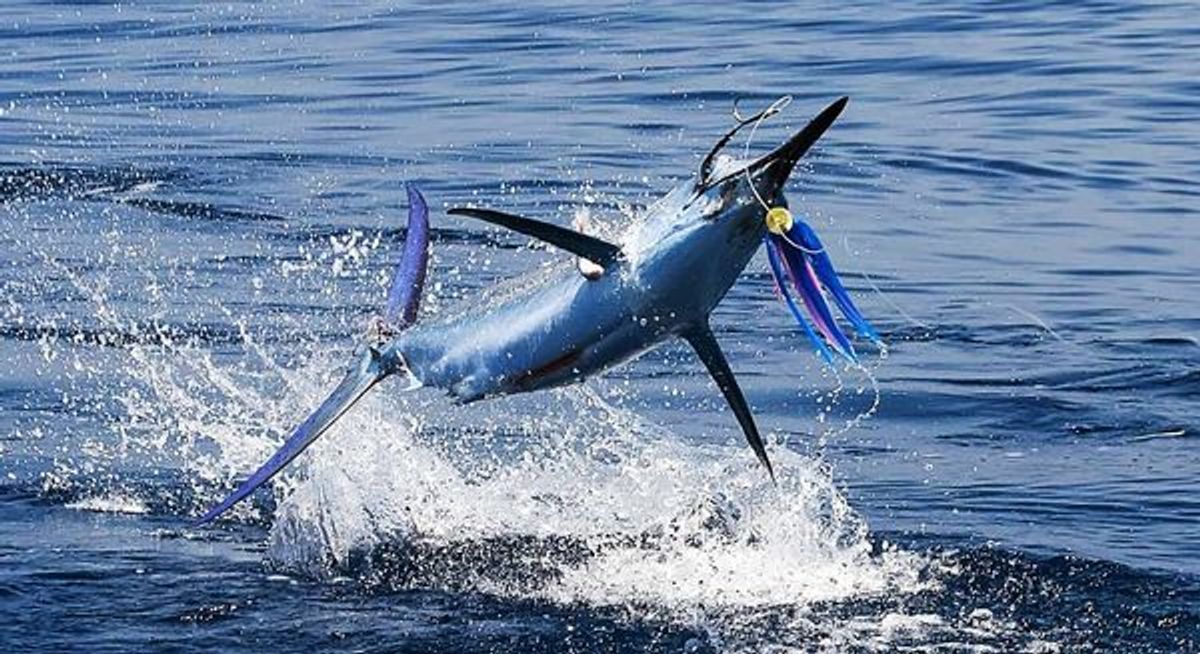
Its large, rounded pectoral fins fold perfectly against its body, granting it exceptional hydrodynamics. It is one of the fastest swimmers in the ocean, virtually identical to the sailfish, with only one notable difference: its dorsal fin is much smaller than the spectacular "sail" of its cousin.
The interesting thing about the "bill" is that it is nothing more than an extension of the nasal bones of the jaw, and it completely lacks nerve sensitivity, so the fish feels no pain when hooked.
DISTRIBUTION AND HABITAT
It inhabits the tropical and subtropical waters of the Atlantic, from the coast of North Carolina to Brazil, spanning the entire Caribbean. It is also common along the African coast, from South Africa to the Mediterranean and northern Portugal, Spain, and France.
It is a pelagic fish that lives in deep areas, generally between 60 and 150 meters deep, although it occasionally descends further. It prefers surface water temperatures between 22 and 27 °C, salinity from 35 to 37 parts per thousand, and areas with moderate currents (0.5 to 2 knots).
Its natural predators are the great white shark and the mako shark.
CHARACTERISTICS AND BEHAVIOR
- Size and weight: It can reach up to 3 meters in length, with an average of 2.10 meters and a maximum weight close to 90 kilos (200 lbs).
- Coloration: It features a first blue dorsal fin with black spots and a rounded tip. The back is blackish-blue, the sides have a brownish tone, while the middle and lower areas display a silvery white color.
- Sexual dimorphism: Females are larger than males. During reproduction, morphological changes occur that allow them to be distinguished; in other stages, size is the only indicator.
- Feeding and social life: It feeds on flying fish and squid. It generally moves in small groups or pairs.
- Reproduction: It migrates to subtropical waters to breed in current areas with temperatures between 20 and 29 °C.
CONSERVATION STATUS
The white marlin population has declined considerably due to indiscriminate and unsustainable fishing. Worldwide, measures and regulations have been implemented to prevent its extinction. In commercial fishing, it is a victim of nets and longlines that do not distinguish between species.
An important truth: these billfish are far more valuable to humanity when they remain alive in their natural habitat.
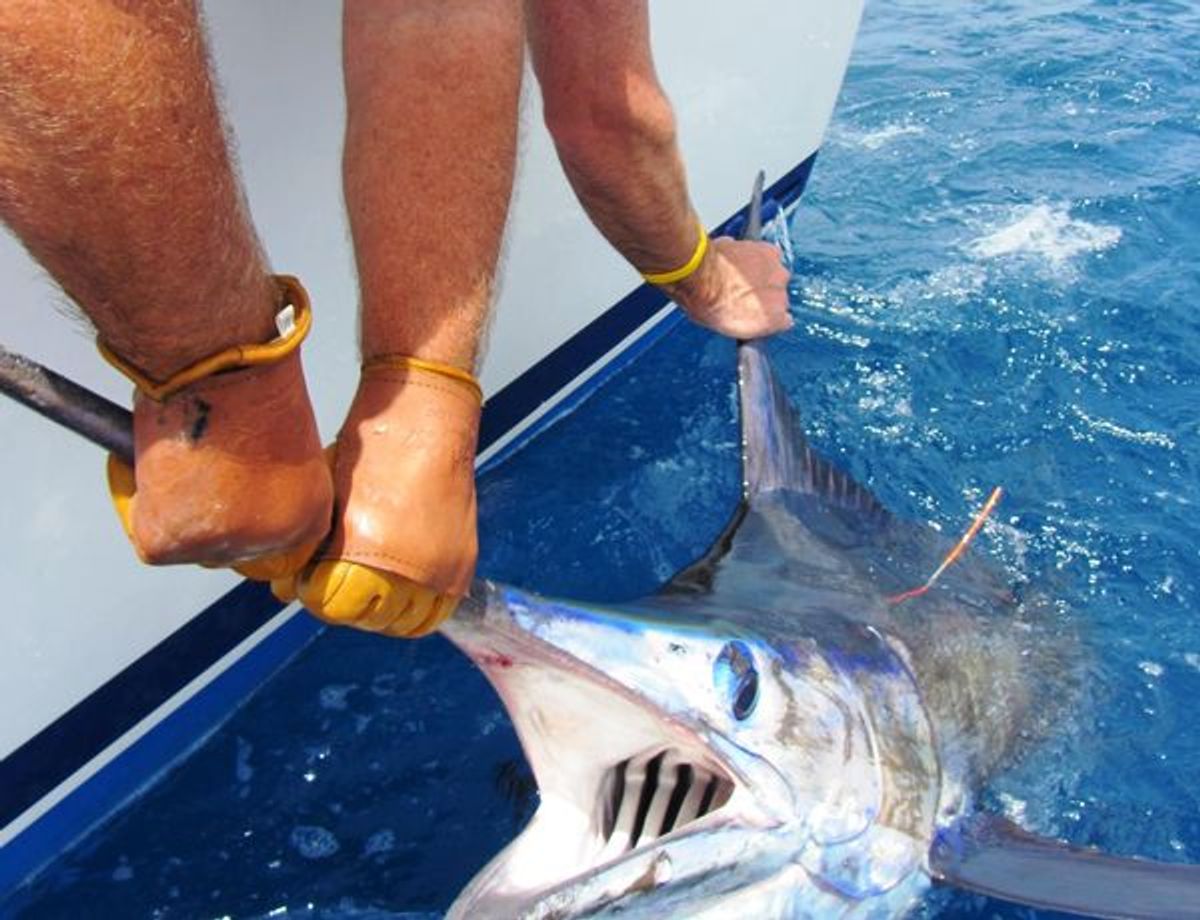
In the sport fishing realm, protection includes catch and release tournaments and the mandatory use of circle hooks.
Note: Studies are still underway to determine whether there is a single highly migratory population in the Atlantic or two populations distributed on both shores.
GUIDE TO ITS SPORT FISHING
Every proper sporting fight belongs to a single angler. No one should take over during the fight, not even by touching the rod to assist. That is the true greatness of this sport.
Although the white marlin is a medium-sized opponent, its run is explosive and requires experience. It must be kept as close as possible to the boat to minimize stress and allow for a successful release.
METHODS AND GEAR
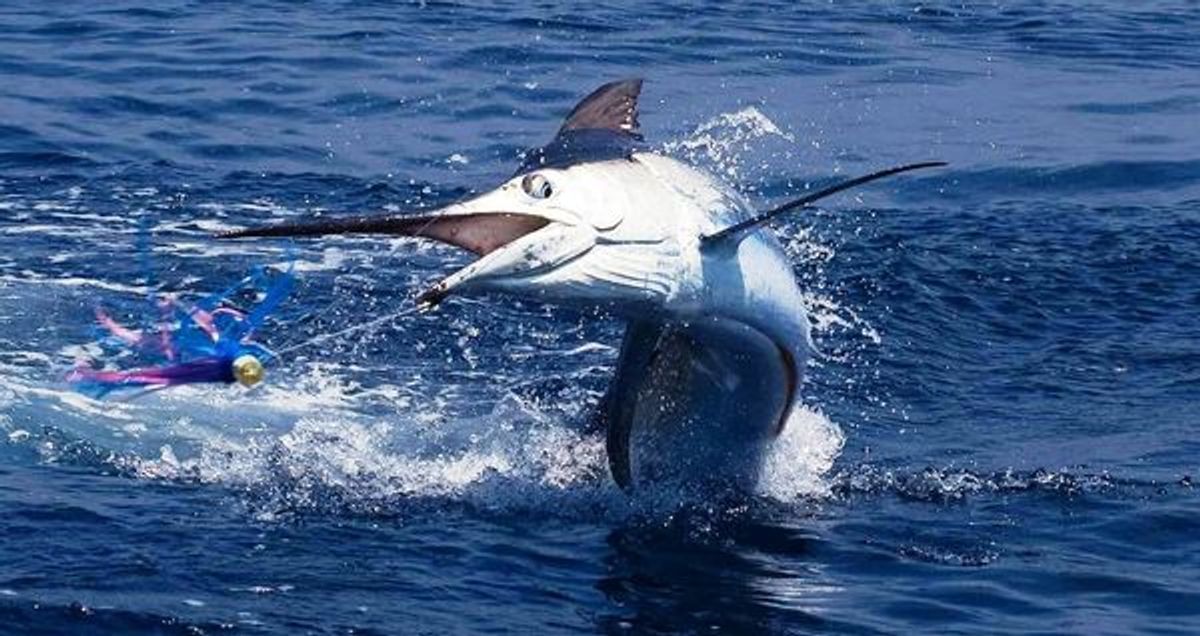
Trolling is the most effective method, although popping or jigging can also be used, with catches in those cases being more incidental.
Location: It is fished more than 12 miles off the coast, requiring boats equipped for offshore fishing with good length and preferably fitted with a flybridge.
Recommended gear:
- Stand-up rods and 50-pound reels (does not require a fighting chair).
- 150-pound leader (more for the leaderman's comfort than for strength).
- Five rods arranged in an inverted fan shape, covering distances from 15 meters behind the stern up to about 65 meters away.
Trolling speed: 8.5 knots and above.
WITH ARTIFICIAL LURES
Outriggers are used to keep the lures at a distance and on the surface. The best ones imitate squid or small fish, ranging in size from 10 to 20 centimeters.
Effective colors: Blue/white, pink/white, or red/white. Preferably in Mylar (brands like Mirrolure).
Heads: Bullet-shaped or cupped/perforated to generate turbulence and froth while trolling.
It is common to use teasers in front of the main lures, with two medium-sized single hooks in the typical rigging for billfish.
WITH NATURAL BAIT
It begins with hookless lures to attract the fish. A flybridge or tuna tower is essential to observe surface strikes.
When the animal strikes (without hooks, obviously it isn't caught), that rod is retrieved and replaced with real live or dead bait rigged with circle hooks. Upon detecting the real bait, the fish will strike for good. At that moment, the rest of the rods are cleared to begin the fight.
Popular option: Ballyhoo alone or with a skirt over them, which work exceptionally well combined with lures, adding volume and action to the presentation.
Final tip: Remember that if instead of a white marlin a blue marlin strikes (its stronger and more powerful cousin), you will need heavier tackle and a fighting chair. There are always surprises at sea!
#WhiteMarlin #SportFishing #MarineConservation