

SPIRIT OF AUSTRALIA: THE WORLD'S FASTEST BOAT BUILT IN A BACKYARD

The Spirit of Australia holds the world water speed record at 511.11 km/h—a mark set over four decades ago that remains unbroken. Most remarkably, this revolutionary vessel was designed, built (and piloted) by Ken Warby in his Sydney backyard, using wood and readily available materials.
On October 8, 1978, Warby took the Spirit of Australia to Blowering Dam Reservoir in New South Wales and achieved an official average speed of 511.11 km/h (317.58 mph), with even higher peak speeds. This feat was made possible by a Westinghouse J34 jet engine—originally designed for fighter jets—ingeniously adapted to propel this unique craft.
KEN WARBY'S LEGACY
Ken Warby (May 9, 1939 – February 20, 2023) was an Australian mechanical engineer and pilot who revolutionized high-speed boating. Inspired by Donald Campbell—a legend of land and water speed racing—Warby channeled his passion into building the Spirit of Australia.
Following his historic achievement, the vessel was donated to the Australian National Maritime Museum in Sydney, where it remains on permanent display as a tribute to his legacy.
Although Warby passed away in 2023 at the age of 83, his influence endures among new generations of engineers and speed enthusiasts, inspiring projects such as the Spirit of Australia II.
CURRENT STATUS OF THE SPIRIT OF AUSTRALIA II
The Spirit of Australia II remains under active development, aiming to break the world water speed record set by Ken Warby in 1978.
The project is led by David Warby—Ken's son—who serves as both the boat's builder and pilot.
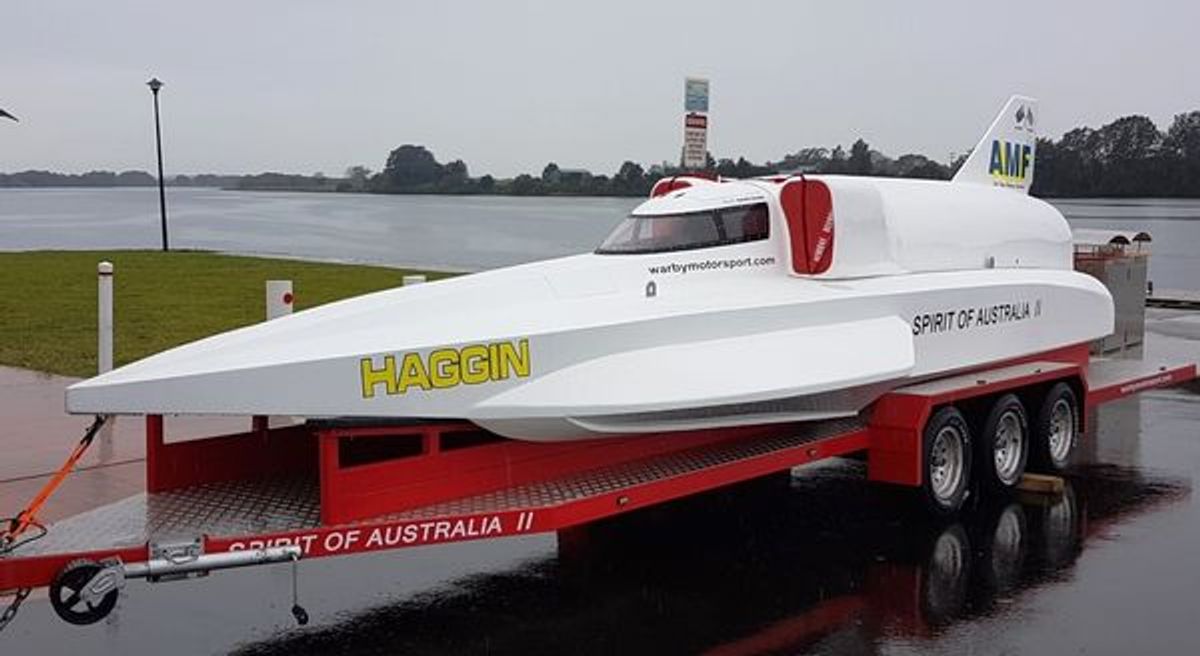
The highest speed reached so far is 447 km/h (278 mph), achieved during a test run at Blowering Dam in August 2024.
This marked a significant milestone for the team following years of development and technical adjustments.
NEW MODEL FEATURES
The Spirit of Australia II is powered by a Rolls-Royce Orpheus 803 jet engine, originally designed for the Italian Air Force's Fiat G.91 fighter jet.
The prototype boasts approximately 50% more power than the original and has a theoretical top speed of 370 mph (595 km/h), according to the specialized outlet powerboat.news.
CURRENT CHALLENGES
Regulatory restrictions: Unlike in Ken's era, testing requires permits and bookings made months in advance. The team gets only about three testing opportunities per year.
Water conditions: The team requires specific conditions—specifically, a light wind of around 5 km/h—to break the water's surface tension without creating dangerous waves.
Fluctuating water levels: At times, reservoir levels are at just 30% capacity, significantly limiting the available testing area.
#SpiritOfAustralia #HomegrownEngineering